
Absolute and Relative Singularity According to the Hadith Scholars
DOI:
https://doi.org/10.25130/jis.25.16.9.3.13Keywords:
Singularity, absolute, relative, mohadithenAbstract
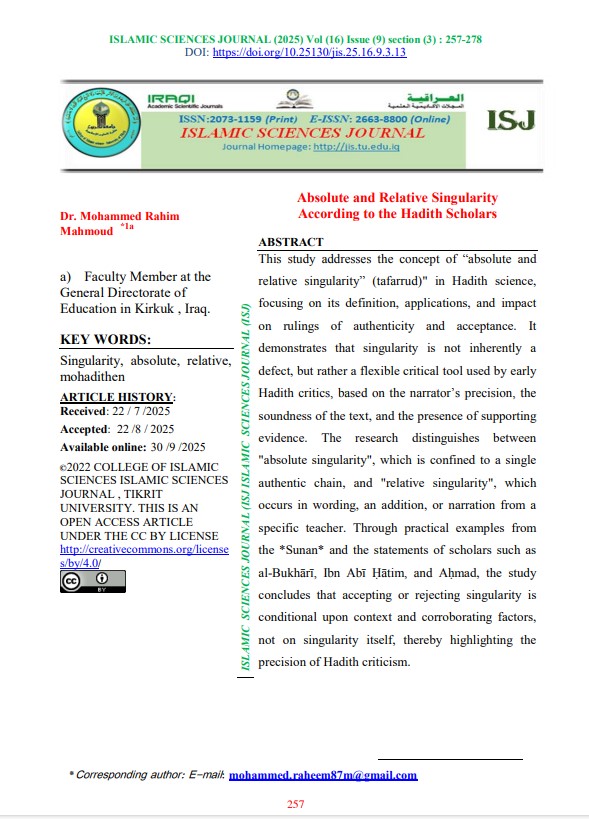
This study addresses the concept of “absolute and relative singularity” (tafarrud)" in Hadith science, focusing on its definition, applications, and impact on rulings of authenticity and acceptance. It demonstrates that singularity is not inherently a defect, but rather a flexible critical tool used by early Hadith critics, based on the narrator’s precision, the soundness of the text, and the presence of supporting evidence. The research distinguishes between "absolute singularity", which is confined to a single authentic chain, and "relative singularity", which occurs in wording, an addition, or narration from a specific teacher. Through practical examples from the *Sunan* and the statements of scholars such as al-Bukhārī, Ibn Abī Ḥātim, and Aḥmad, the study concludes that accepting or rejecting singularity is conditional upon context and corroborating factors, not on singularity itself, thereby highlighting the precision of Hadith criticism.
Downloads
Published
Issue
Section
Categories
License
Copyright (c) 2026 THIS IS AN OPEN ACCESS ARTICLE UNDER THE CC BY LICENSE http://creativecommons.org/licenses/by/4.0/

This work is licensed under a Creative Commons Attribution 4.0 International License.
COLLEGE OF ISLAMIC SCIENCES, TIKRIT UNIVERSITY. THIS IS AN OPEN ACCESS ARTICLE UNDER THE CC BY LICENSE http://creativecommons.org/licenses/by/4.0/