
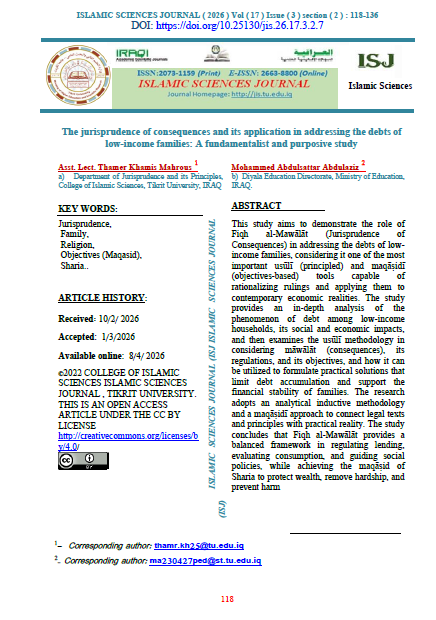
The jurisprudence of consequences and its application in addressing the debts of low-income families: A fundamentalist and purposive study
DOI:
https://doi.org/10.25130/jis.26.17.3.2.7Keywords:
Jurisprudence, Family, Religion, Objectives (Maqasid), ShariaAbstract
This study aims to demonstrate the role of Fiqh al-Mawālāt (Jurisprudence of Consequences) in addressing the debts of low-income families, considering it one of the most important usūlī (principled) and maqāṣidī (objectives-based) tools capable of rationalizing rulings and applying them to contemporary economic realities. The study provides an in-depth analysis of the phenomenon of debt among low-income households, its social and economic impacts, and then examines the usūlī methodology in considering māwālāt (consequences), its regulations, and its objectives, and how it can be utilized to formulate practical solutions that limit debt accumulation and support the financial stability of families. The research adopts an analytical inductive methodology and a maqāṣidī approach to connect legal texts and principles with practical reality. The study concludes that Fiqh al-Mawālāt provides a balanced framework in regulating lending, evaluating consumption, and guiding social policies, while achieving the maqāṣid of Sharia to protect wealth, remove hardship, and prevent harm
Downloads
Published
Issue
Section
Categories
License
Copyright (c) 2026 THIS IS AN OPEN ACCESS ARTICLE UNDER THE CC BY LICENSE http://creativecommons.org/licenses/by/4.0/

This work is licensed under a Creative Commons Attribution 4.0 International License.
COLLEGE OF ISLAMIC SCIENCES, TIKRIT UNIVERSITY. THIS IS AN OPEN ACCESS ARTICLE UNDER THE CC BY LICENSE http://creativecommons.org/licenses/by/4.0/