
The Effect of the Power of Thinking Strategy on the Achievement of Fifth-Grade Preparatory School Students in the Subject of the Noble Qur’an and Islamic Education, and the Development of their Mental Skills
DOI:
https://doi.org/10.25130/jis.21.12.5.4Keywords:
Thinking power, characteristics, mental skills, experimental method, presentation of results .Abstract
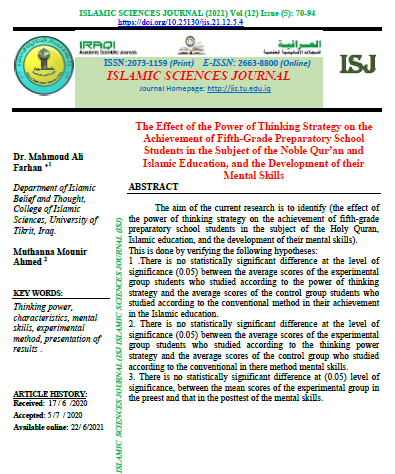
The aim of the current research is to identify (the effect of the power of thinking strategy on the achievement of fifth-grade preparatory school students in the subject of the Holy Quran, Islamic education, and the development of their mental skills).
This is done by verifying the following hypotheses:
1. There is no statistically significant difference at the level of significance (0.05) between the average scores of the experimental group students who studied according to the power of thinking strategy and the average scores of the control group students who studied according to the conventional method in their achievement in the Islamic education.
2. There is no statistically significant difference at the level of significance (0.05) between the average scores of the experimental group students who studied according to the thinking power strategy and the average scores of the control group who studied according to the conventional in there method mental skills.
3. There is no statistically significant difference at (0.05) level of significance, between the mean scores of the experimental group in the preest and that in the posttest of the mental skills.
Downloads
Published
Issue
Section
License
Copyright (c) 2023 THIS IS AN OPEN ACCESS ARTICLE UNDER THE CC BY LICENSE http://creativecommons.org/licenses/by/4.0/

This work is licensed under a Creative Commons Attribution 4.0 International License.
COLLEGE OF ISLAMIC SCIENCES, TIKRIT UNIVERSITY. THIS IS AN OPEN ACCESS ARTICLE UNDER THE CC BY LICENSE http://creativecommons.org/licenses/by/4.0/