
خصوصية المرأة في الفقه الإسلامي والقانون العراقي- دراسة تأصيلية - حد الحرابة انموذجاً
الشريط الجانبي للمقالة
محتوى المقالة الرئيسي
الملخص
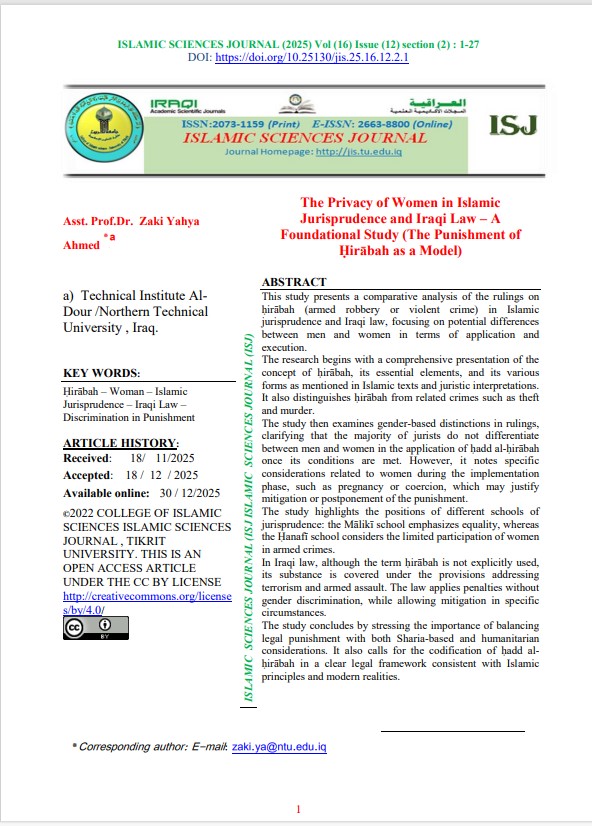
This study presents a comparative analysis of the rulings on ḥirābah (armed robbery or violent crime) in Islamic jurisprudence and Iraqi law, focusing on potential differences between men and women in terms of application and execution.
The research begins with a comprehensive presentation of the concept of ḥirābah, its essential elements, and its various forms as mentioned in Islamic texts and juristic interpretations. It also distinguishes ḥirābah from related crimes such as theft and murder.
The study then examines gender-based distinctions in rulings, clarifying that the majority of jurists do not differentiate between men and women in the application of ḥadd al-ḥirābah once its conditions are met. However, it notes specific considerations related to women during the implementation phase, such as pregnancy or coercion, which may justify mitigation or postponement of the punishment.
The study highlights the positions of different schools of jurisprudence: the Mālikī school emphasizes equality, whereas the Ḥanafī school considers the limited participation of women in armed crimes.
In Iraqi law, although the term ḥirābah is not explicitly used, its substance is covered under the provisions addressing terrorism and armed assault. The law applies penalties without gender discrimination, while allowing mitigation in specific circumstances.
The study concludes by stressing the importance of balancing legal punishment with both Sharia-based and humanitarian considerations. It also calls for the codification of ḥadd al-ḥirābah in a clear legal framework consistent with Islamic principles and modern realities
تفاصيل المقالة

هذا العمل مرخص بموجب Creative Commons Attribution 4.0 International License.
COLLEGE OF ISLAMIC SCIENCES, TIKRIT UNIVERSITY. THIS IS AN OPEN ACCESS ARTICLE UNDER THE CC BY LICENSE http://creativecommons.org/licenses/by/4.0/