
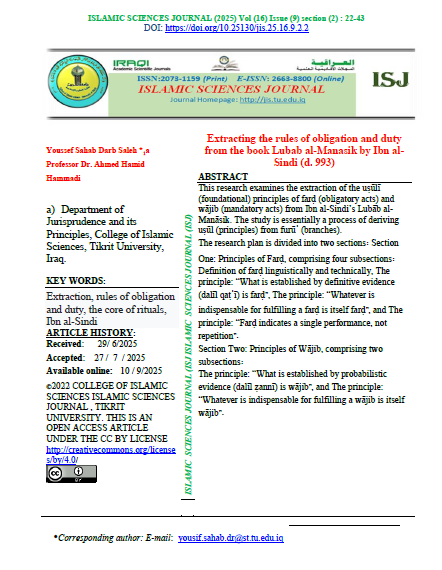
Extracting the rules of obligation and duty from the book Lubab al-Manasik by Ibn al-Sindi (d. 993)
Article Sidebar
Main Article Content
Abstract
This research examines the extraction of the uṣūlī (foundational) principles of farḍ (obligatory acts) and wājib (mandatory acts) from Ibn al-Sindi’s Lubāb al-Manāsik. The study is essentially a process of deriving uṣūl (principles) from furūʿ (branches).
The research plan is divided into two sections: Section One: Principles of Farḍ, comprising four subsections: Definition of farḍ linguistically and technically, The principle: “What is established by definitive evidence (dalīl qaṭʿī) is farḍ”, The principle: “Whatever is indispensable for fulfilling a farḍ is itself farḍ”, and The principle: “Farḍ indicates a single performance, not repetition.”
Section Two: Principles of Wājib, comprising two subsections:
The principle: “What is established by probabilistic evidence (dalīl ẓannī) is wājib”, and The principle: “Whatever is indispensable for fulfilling a wājib is itself wājib
Article Details

This work is licensed under a Creative Commons Attribution 4.0 International License.
COLLEGE OF ISLAMIC SCIENCES, TIKRIT UNIVERSITY. THIS IS AN OPEN ACCESS ARTICLE UNDER THE CC BY LICENSE http://creativecommons.org/licenses/by/4.0/