
The impact of Internal Determinants on Capital Adequacy: A Case Study Of Kuwaiti Islamic Banks During The Period (2015-2024)
Article Sidebar
Main Article Content
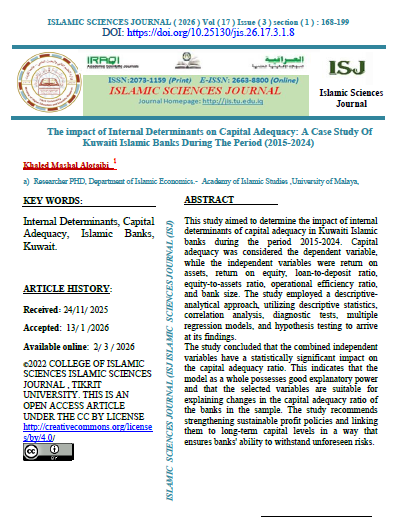
Abstract
This study aimed to determine the impact of internal determinants of capital adequacy in Kuwaiti Islamic banks during the period 2015-2024. Capital adequacy was considered the dependent variable, while the independent variables were return on assets, return on equity, loan-to-deposit ratio, equity-to-assets ratio, operational efficiency ratio, and bank size. The study employed a descriptive-analytical approach, utilizing descriptive statistics, correlation analysis, diagnostic tests, multiple regression models, and hypothesis testing to arrive at its findings.
The study concluded that the combined independent variables have a statistically significant impact on the capital adequacy ratio. This indicates that the model as a whole possesses good explanatory power and that the selected variables are suitable for explaining changes in the capital adequacy ratio of the banks in the sample. The study recommends strengthening sustainable profit policies and linking them to long-term capital levels in a way that ensures banks' ability to withstand unforeseen risks.
Article Details

This work is licensed under a Creative Commons Attribution 4.0 International License.
COLLEGE OF ISLAMIC SCIENCES, TIKRIT UNIVERSITY. THIS IS AN OPEN ACCESS ARTICLE UNDER THE CC BY LICENSE http://creativecommons.org/licenses/by/4.0/