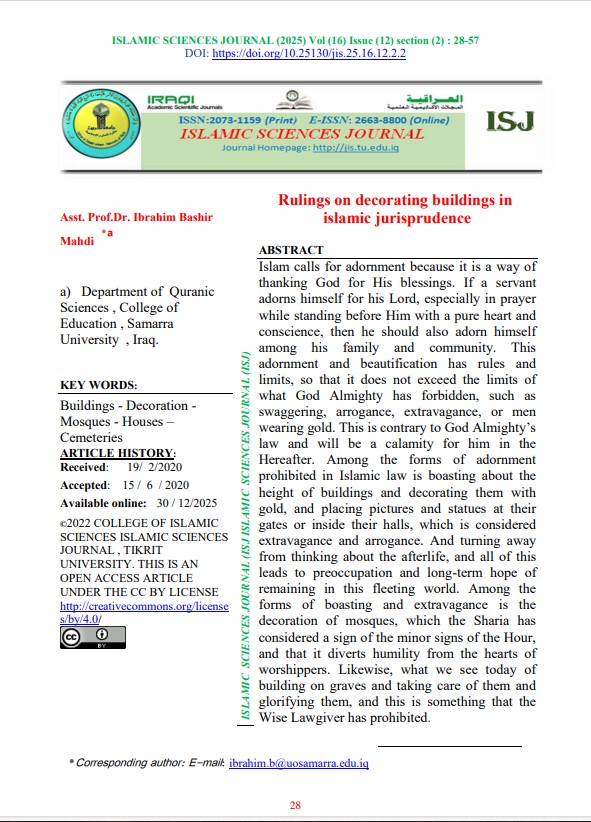
Rulings on decorating buildings in islamic jurisprudence
Article Sidebar
Main Article Content
Abstract
Islam calls for adornment because it is a way of thanking God for His blessings. If a servant adorns himself for his Lord, especially in prayer while standing before Him with a pure heart and conscience, then he should also adorn himself among his family and community. This adornment and beautification has rules and limits, so that it does not exceed the limits of what God Almighty has forbidden, such as swaggering, arrogance, extravagance, or men wearing gold. This is contrary to God Almighty’s law and will be a calamity for him in the Hereafter. Among the forms of adornment prohibited in Islamic law is boasting about the height of buildings and decorating them with gold, and placing pictures and statues at their gates or inside their halls, which is considered extravagance and arrogance. And turning away from thinking about the afterlife, and all of this leads to preoccupation and long-term hope of remaining in this fleeting world. Among the forms of boasting and extravagance is the decoration of mosques, which the Sharia has considered a sign of the minor signs of the Hour, and that it diverts humility from the hearts of worshippers. Likewise, what we see today of building on graves and taking care of them and glorifying them, and this is something that the Wise Lawgiver has prohibited
Article Details

This work is licensed under a Creative Commons Attribution 4.0 International License.
COLLEGE OF ISLAMIC SCIENCES, TIKRIT UNIVERSITY. THIS IS AN OPEN ACCESS ARTICLE UNDER THE CC BY LICENSE http://creativecommons.org/licenses/by/4.0/