
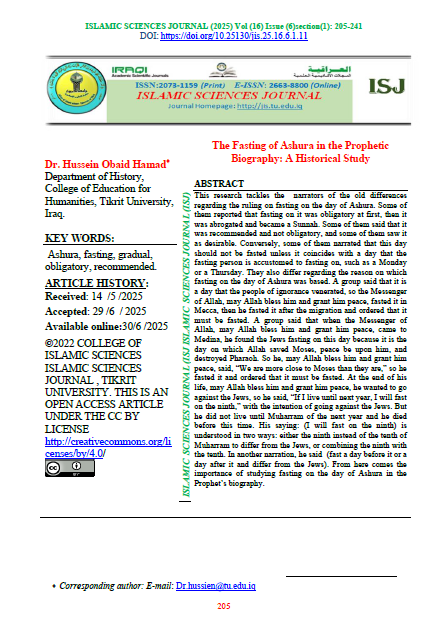
The Fasting of Ashura in the Prophetic Biography: A Historical Study
Article Sidebar
Main Article Content
Abstract
This research tackles the narrators of the old differences regarding the ruling on fasting on the day of Ashura. Some of them reported that fasting on it was obligatory at first, then it was abrogated and became a Sunnah. Some of them said that it was recommended and not obligatory, and some of them saw it as desirable. Conversely, some of them narrated that this day should not be fasted unless it coincides with a day that the fasting person is accustomed to fasting on, such as a Monday or a Thursday. They also differ regarding the reason on which fasting on the day of Ashura was based. A group said that it is a day that the people of ignorance venerated, so the Messenger of Allah, may Allah bless him and grant him peace, fasted it in Mecca, then he fasted it after the migration and ordered that it must be fasted. A group said that when the Messenger of Allah, may Allah bless him and grant him peace, came to Medina, he found the Jews fasting on this day because it is the day on which Allah saved Moses, peace be upon him, and destroyed Pharaoh. So he, may Allah bless him and grant him peace, said, “We are more close to Moses than they are,” so he fasted it and ordered that it must be fasted. At the end of his life, may Allah bless him and grant him peace, he wanted to go against the Jews, so he said, “If I live until next year, I will fast on the ninth,” with the intention of going against the Jews. But he did not live until Muharram of the next year and he died before this time. His saying: (I will fast on the ninth) is understood in two ways: either the ninth instead of the tenth of Muharram to differ from the Jews, or combining the ninth with the tenth. In another narration, he said (fast a day before it or a day after it and differ from the Jews). From here comes the importance of studying fasting on the day of Ashura in the Prophet’s biography.
Article Details

This work is licensed under a Creative Commons Attribution 4.0 International License.
COLLEGE OF ISLAMIC SCIENCES, TIKRIT UNIVERSITY. THIS IS AN OPEN ACCESS ARTICLE UNDER THE CC BY LICENSE http://creativecommons.org/licenses/by/4.0/