Cursing Between Wisdom and Evidence
Article Sidebar
Main Article Content
Abstract
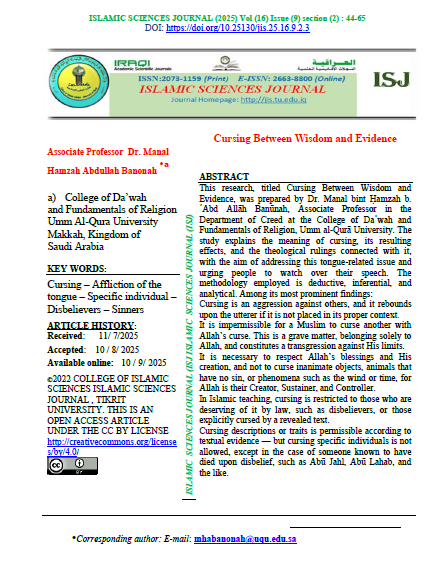
This research, titled Cursing Between Wisdom and Evidence, was prepared by Dr. Manal bint Ḥamzah b. ʿAbd Allāh Banūnah, Associate Professor in the Department of Creed at the College of Daʿwah and Fundamentals of Religion, Umm al-Qurā University. The study explains the meaning of cursing, its resulting effects, and the theological rulings connected with it, with the aim of addressing this tongue-related issue and urging people to watch over their speech. The methodology employed is deductive, inferential, and analytical. Among its most prominent findings:
Cursing is an aggression against others, and it rebounds upon the utterer if it is not placed in its proper context.
It is impermissible for a Muslim to curse another with Allah’s curse. This is a grave matter, belonging solely to Allah, and constitutes a transgression against His limits.
It is necessary to respect Allah’s blessings and His creation, and not to curse inanimate objects, animals that have no sin, or phenomena such as the wind or time, for Allah is their Creator, Sustainer, and Controller.
In Islamic teaching, cursing is restricted to those who are deserving of it by law, such as disbelievers, or those explicitly cursed by a revealed text.
Cursing descriptions or traits is permissible according to textual evidence — but cursing specific individuals is not allowed, except in the case of someone known to have died upon disbelief, such as Abū Jahl, Abū Lahab, and the like
Article Details

This work is licensed under a Creative Commons Attribution 4.0 International License.
COLLEGE OF ISLAMIC SCIENCES, TIKRIT UNIVERSITY. THIS IS AN OPEN ACCESS ARTICLE UNDER THE CC BY LICENSE http://creativecommons.org/licenses/by/4.0/