
Impediments to Legal Capacity: Drugs as a Model - A Comparative Study between Sharia and Law
DOI:
https://doi.org/10.25130/jis.25.16.12.1.11Keywords:
Legal capacity - Impediments - Drugs - Islamic Sharia - Positive lawAbstract
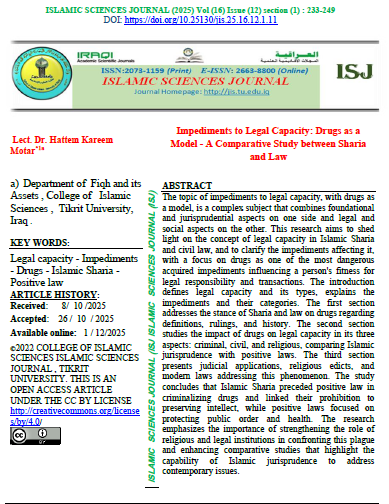
The topic of impediments to legal capacity, with drugs as a model, is a complex subject that combines foundational and jurisprudential aspects on one side and legal and social aspects on the other. This research aims to shed light on the concept of legal capacity in Islamic Sharia and civil law, and to clarify the impediments affecting it, with a focus on drugs as one of the most dangerous acquired impediments influencing a person's fitness for legal responsibility and transactions. The introduction defines legal capacity and its types, explains the impediments and their categories. The first section addresses the stance of Sharia and law on drugs regarding definitions, rulings, and history. The second section studies the impact of drugs on legal capacity in its three aspects: criminal, civil, and religious, comparing Islamic jurisprudence with positive laws. The third section presents judicial applications, religious edicts, and modern laws addressing this phenomenon. The study concludes that Islamic Sharia preceded positive law in criminalizing drugs and linked their prohibition to preserving intellect, while positive laws focused on protecting public order and health. The research emphasizes the importance of strengthening the role of religious and legal institutions in confronting this plague and enhancing comparative studies that highlight the capability of Islamic jurisprudence to address contemporary issues.
Downloads
Published
Issue
Section
Categories
License
Copyright (c) 2026 THIS IS AN OPEN ACCESS ARTICLE UNDER THE CC BY LICENSE http://creativecommons.org/licenses/by/4.0/

This work is licensed under a Creative Commons Attribution 4.0 International License.
COLLEGE OF ISLAMIC SCIENCES, TIKRIT UNIVERSITY. THIS IS AN OPEN ACCESS ARTICLE UNDER THE CC BY LICENSE http://creativecommons.org/licenses/by/4.0/