
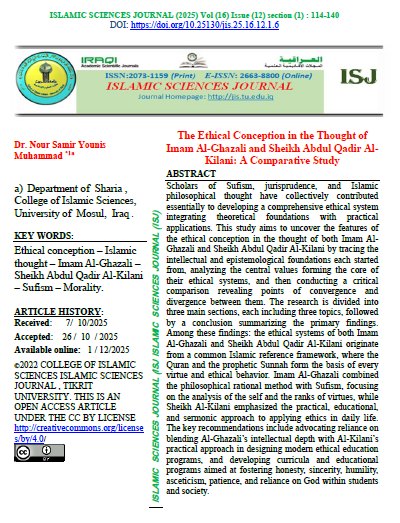
The Ethical Conception in the Thought of Imam Al-Ghazali and Sheikh Abdul Qadir Al-Kilani: A Comparative Study
DOI:
https://doi.org/10.25130/jis.25.16.12.1.6Keywords:
cal conception – Islamic thought – Imam Al-Ghazali – Sheikh Abdul Qadir Al-Kilani – Sufism – Morality.Abstract
Scholars of Sufism, jurisprudence, and Islamic philosophical thought have collectively contributed essentially to developing a comprehensive ethical system integrating theoretical foundations with practical applications. This study aims to uncover the features of the ethical conception in the thought of both Imam Al-Ghazali and Sheikh Abdul Qadir Al-Kilani by tracing the intellectual and epistemological foundations each started from, analyzing the central values forming the core of their ethical systems, and then conducting a critical comparison revealing points of convergence and divergence between them. The research is divided into three main sections, each including three topics, followed by a conclusion summarizing the primary findings. Among these findings: the ethical systems of both Imam Al-Ghazali and Sheikh Abdul Qadir Al-Kilani originate from a common Islamic reference framework, where the Quran and the prophetic Sunnah form the basis of every virtue and ethical behavior. Imam Al-Ghazali combined the philosophical rational method with Sufism, focusing on the analysis of the self and the ranks of virtues, while Sheikh Al-Kilani emphasized the practical, educational, and sermonic approach to applying ethics in daily life. The key recommendations include advocating reliance on blending Al-Ghazali’s intellectual depth with Al-Kilani’s practical approach in designing modern ethical education programs, and developing curricula and educational programs aimed at fostering honesty, sincerity, humility, asceticism, patience, and reliance on God within students and society.
Downloads
Published
Issue
Section
Categories
License
Copyright (c) 2026 THIS IS AN OPEN ACCESS ARTICLE UNDER THE CC BY LICENSE http://creativecommons.org/licenses/by/4.0/

This work is licensed under a Creative Commons Attribution 4.0 International License.
COLLEGE OF ISLAMIC SCIENCES, TIKRIT UNIVERSITY. THIS IS AN OPEN ACCESS ARTICLE UNDER THE CC BY LICENSE http://creativecommons.org/licenses/by/4.0/