
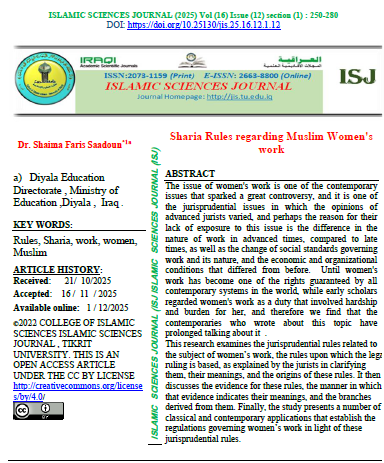
Sharia Rules regarding Muslim Women's work
DOI:
https://doi.org/10.25130/jis.25.16.12.1.12Keywords:
Rules, Sharia, work, women, MuslimAbstract
The issue of women's work is one of the contemporary issues that sparked a great controversy, and it is one of the jurisprudential issues in which the opinions of advanced jurists varied, and perhaps the reason for their lack of exposure to this issue is the difference in the nature of work in advanced times, compared to late times, as well as the change of social standards governing work and its nature, and the economic and organizational conditions that differed from before. Until women's work has become one of the rights guaranteed by all contemporary systems in the world, while early scholars regarded women's work as a duty that involved hardship and burden for her, and therefore we find that the contemporaries who wrote about this topic have prolonged talking about it.
This research examines the jurisprudential rules related to the subject of women’s work, the rules upon which the legal ruling is based, as explained by the jurists in clarifying them, their meanings, and the origins of these rules. It then discusses the evidence for these rules, the manner in which that evidence indicates their meanings, and the branches derived from them. Finally, the study presents a number of classical and contemporary applications that establish the regulations governing women’s work in light of these jurisprudential rules
Downloads
Published
Issue
Section
Categories
License
Copyright (c) 2026 THIS IS AN OPEN ACCESS ARTICLE UNDER THE CC BY LICENSE http://creativecommons.org/licenses/by/4.0/

This work is licensed under a Creative Commons Attribution 4.0 International License.
COLLEGE OF ISLAMIC SCIENCES, TIKRIT UNIVERSITY. THIS IS AN OPEN ACCESS ARTICLE UNDER THE CC BY LICENSE http://creativecommons.org/licenses/by/4.0/